Benchmarks
All numbers measured on the same hardware with a fixed random seed. Raw
scripts live in experiments/;
a reproducible CI-runnable suite is planned.
Headline: IVFPQSnapIndex on FIQA
BEIR FIQA, N = 57,638, dim = 384 (BGE-small), nlist = 512, M = 192, K = 256.
keep_full_precision=True, rerank_candidates=100.
nprobe |
Configuration | recall@10 | Latency (us/query) |
|---|---|---|---|
| 8 | PQ only | 0.85 | 180 |
| 32 | PQ only | 0.92 | 340 |
| 64 | PQ + fp16 rerank | 0.977 | 441 |
| 256 | PQ + fp16 rerank | 0.998 | 1021 |
5.8x speedup vs v0.6 at identical recall, past the PQ-only 0.929 ceiling.
Head-to-head: snapvec vs FAISS vs hnswlib vs sqlite-vec
Single unified table across every backend tested, at their standard operating points and at matched-budget points where we have a comparable PQ config. Goal is to let the reader see the full Pareto shape rather than cherry-picked wins.
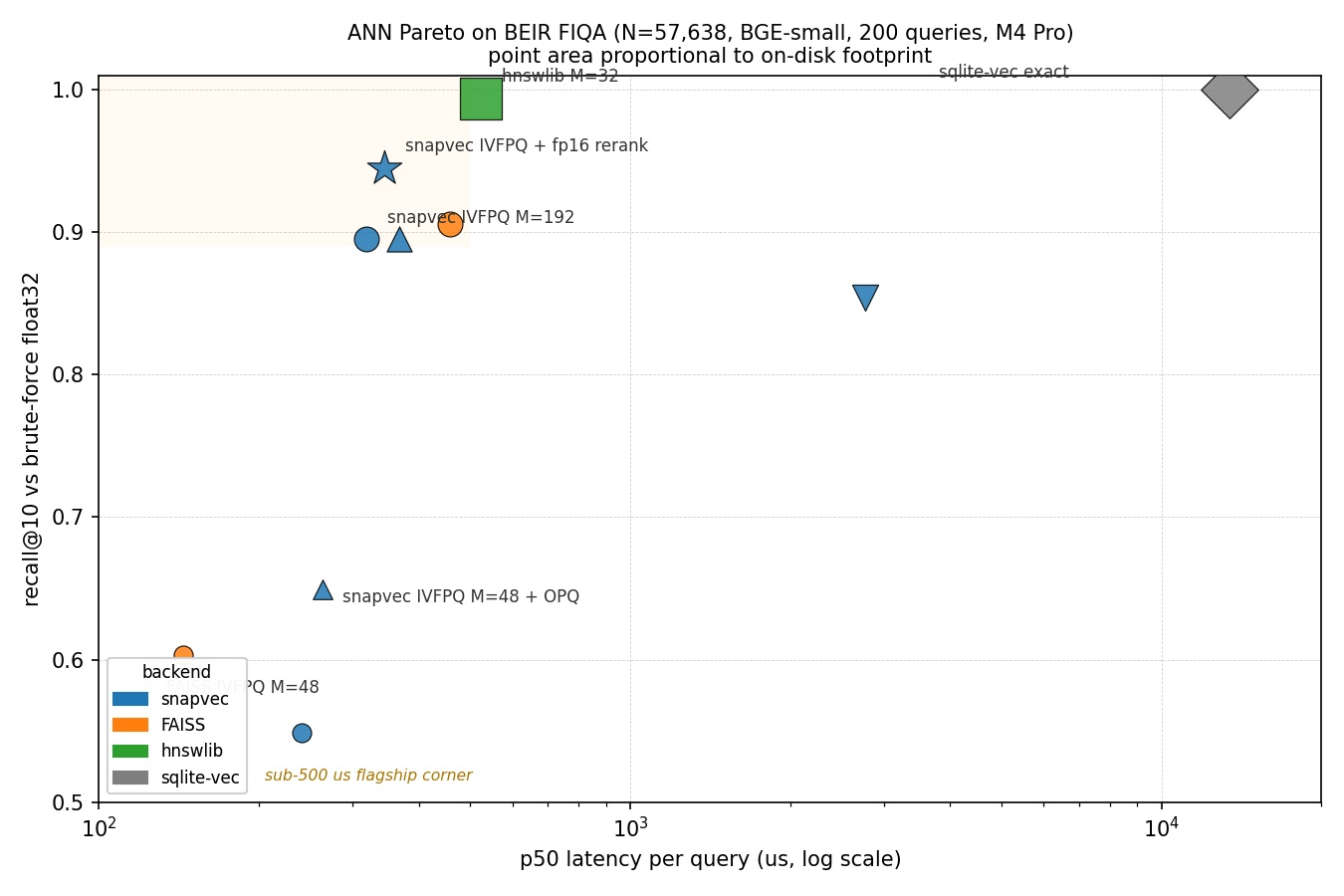
Point area is proportional to the on-disk footprint of the index file (the third axis of the tradeoff). Rows sitting up-and-left are the frontier; anything further down-and-right is dominated.
Scope and methodology
Dataset. BEIR FIQA, one of the BEIR retrieval benchmarks. Embeddings are BGE-small (dim = 384), corpus N = 57,638, unit-normalised. 200 queries sampled from the 648 test queries. Ground truth is float32 brute-force top-10 dot product on the same unit-normalised corpus (recall@10 is against exact NN).
Hardware. Apple M4 Pro, 12 cores, 24 GB RAM, macOS 14.
Every backend pinned to a single thread
(faiss.omp_set_num_threads(1) at module level, and
idx.set_num_threads(1) on the hnswlib instance; snapvec default
is already serial) for apples-to-apples per-query latency.
GC disabled inside the timing loop. p50 and p99 reported
across the query set (median, not mean, to shrug off outliers).
Versions. snapvec 0.11.0, faiss-cpu 1.13.2, hnswlib 0.8.0, sqlite-vec 0.1.7, NumPy 2.4.3, Python 3.12.
What this table isn't. Evidence that snapvec beats FAISS on
your dataset. Modern embeddings vary in coordinate-variance
shape, and OPQ gains in particular are distribution-dependent.
Run python experiments/bench_competitive.py on your own
corpus before citing these numbers in a design review.
Every row below is approximate (recall < 1.0) except sqlite-vec,
which is an exact brute-force scan. snapvec has no exact mode --
every SnapIndex / PQSnapIndex / IVFPQSnapIndex variant quantizes
the vectors on ingest, so the lowest-tier SnapIndex 4-bit row is
"full-scan + scalar quantization", not flat-exact in the FAISS
IndexFlat sense. For flat-exact behaviour with snapvec's storage
story, use sqlite-vec or FAISS IndexFlatIP.
| Backend | recall@10 | p50 us | p99 us | disk MB | build s |
|---|---|---|---|---|---|
| sqlite-vec (brute-force cosine, exact) | 1.000 | 13401 | 40936 | 91.1 | 0.6 |
| hnswlib (M=32, ef_search=128) | 0.994 | 524 | 824 | 104.5 | 44 |
| snapvec IVFPQ + fp16 rerank (M=192) | 0.945 | 345 | 510 | 56.9 | 111 |
| FAISS IVFPQ (M=192) [matched-budget] | 0.906 | 457 | 550 | 12.7 | 17 |
| snapvec IVFPQ no rerank (M=192) | 0.895 | 319 | 502 | 12.6 | 110 |
| snapvec IVFPQ no rerank (M=192) + OPQ | 0.895 | 368 | 557 | 13.2 | 112 |
| snapvec SnapIndex 4-bit scalar (full-scan) | 0.854 | 2764 | 3099 | 15.4 | 1.1 |
| snapvec SnapIndex 3-bit scalar (full-scan) | 0.736 | 2742 | 3815 | 11.7 | 0.8 |
| snapvec IVFPQ no rerank (M=48) + OPQ | 0.649 | 263 | 331 | 4.9 | 33 |
| snapvec SnapIndex 2-bit scalar (full-scan) | 0.618 | 2740 | 5594 | 8.0 | 0.7 |
| FAISS IVFPQ (M=48) | 0.603 | 144 | 217 | 4.4 | 10 |
| snapvec IVFPQ no rerank (M=48) [matched-budget] | 0.549 | 241 | 319 | 4.3 | 34 |
Rows ordered by recall@10 descending.
Methodology. All numbers come from a single end-to-end invocation
of experiments/bench_competitive.py. The orchestrator spawns one
subprocess per backend (each backend bundles its own libomp; loading
two into the same Python process crashes on macOS arm64) but all four
subprocesses run back-to-back in one session so OS page-cache state
does not drift between earlier and later rows. An earlier
multi-session measurement showed a ~56% p50 delta on SnapIndex between
cold and warm runs; the single-invocation convention above eliminates
that.
Thread pinning: faiss.omp_set_num_threads(1) + idx.set_num_threads(1)
on the hnswlib instance (set before add_items) for apples-to-apples
build and search timings. snapvec's fit still uses whatever NumPy
BLAS is configured to; for this machine np.show_config() reports
Accelerate with its default thread count. Expected run-to-run noise
on this hardware is <=5% p50 for every row except hnswlib, which
hits ~10-15% routinely.
Reading the table
The Pareto frontier (no backend strictly dominated) is:
- Aggressive-compression corner (~4.5 MB) is a recall-vs-latency
trade: FAISS IVFPQ M=48 takes the fastest-at-this-disk point
(0.603 recall at 144 us), snapvec IVFPQ M=48 + OPQ takes the
highest-recall point (0.649 recall at 263 us). Baseline snapvec
at M=48 without OPQ is dominated (lower recall than FAISS at
higher latency) -- reach for
use_opq=Trueat this budget. - snapvec IVFPQ M=192 matches FAISS M=192 on disk (12.6 vs 12.7 MB) and on recall (0.895 vs 0.906) while being 1.4x faster at p50 (319 vs 457 us). This is the matched-budget headline. OPQ at M=192 is not worth it (same recall, +16% latency, +576 KB disk): the 2-dim subspaces have no room for the rotation.
- snapvec IVFPQ + fp16 rerank is the Pareto-dominant high-recall point under 500 us: 0.945 recall at 345 us -- faster than FAISS M=192 AND higher recall, at the cost of a 4.5x larger index file (holds a float16 copy for the rerank pass).
- hnswlib reaches the highest non-exact recall (0.994) but pays with disk (104 MB) and p99 latency (824 us).
- sqlite-vec is exact (recall 1.000) but its brute-force cosine scan is 13.4 ms -- ~40x slower than any of the ANN backends on this N. It's the 'zero ANN tuning, accept the latency' baseline.
Positioning in plain language
- If you need one dependency, no training, acceptable latency on
small N:
SnapIndexat 4-bit scalar or sqlite-vec. snapvec is ~5x faster (2.7 ms vs 13.9 ms) but gives up exactness (0.85 vs 1.00 recall) because it quantizes the vectors.SnapIndexp50 latency is essentially constant across bit depths (the fp16 centroid-expansion matmul dominates); the recall/disk tradeoff is the only knob you turn. - If you have space for PQ training and want aggressive disk
compression (~4-5 MB): two viable picks. FAISS IVFPQ M=48 is
the fastest (144 us p50, 0.603 recall). snapvec IVFPQ M=48 +
use_opq=Trueis the highest recall (0.649) at 1.8x the latency (263 us). Both at ~identical disk. - If you want matched disk and the fastest ANN latency for recall ~0.9: snapvec IVFPQ M=192.
- If you want recall approaching 0.95 in sub-millisecond latency: snapvec IVFPQ + fp16 rerank (4.5x disk for ~5 pp recall lift).
- If you want the highest recall regardless of disk / tail latency: hnswlib.
Caveats
- FAISS
fitis ~6.5x faster than snapvec'sfitat the same config (17 s vs 110 s at M=192). Build time is a real competitive gap. - At M=48 without OPQ, FAISS's PQ training beats snapvec's.
Turning on
use_opq=Trueflips that: snapvec + OPQ hits 0.649 recall at M=48 versus FAISS's 0.603, at comparable disk (4.9 vs 4.4 MB). Baseline (non-OPQ) snapvec is dominated on this corner so reach foruse_opq=Trueat aggressive compression. - These are serial per-query numbers. hnswlib in particular gets a large speedup from its default thread pool; the [threading curve] section covers how snapvec scales batched search.
Reproduce with python experiments/bench_competitive.py after
caching both experiments/.cache_fiqa_bge_small.npy and
experiments/.cache_fiqa_queries_bge_small.npy.
OPQ rotation: recall vs M (single dataset)
Scope. These numbers come from one dataset, BEIR FIQA with BGE-small. OPQ gains depend on the source distribution; on datasets with near-isotropic coordinate variance the rotation has nothing to redistribute. Treat this as "OPQ's behaviour on modern sentence embeddings" rather than a universal claim.
Setup identical to the competitive table: N = 57,638, dim = 384, nlist = 512, normalized=True, rerank disabled. 300 queries sampled from FIQA's test set.
M |
d_sub |
recall@10 (baseline) | recall@10 (OPQ) | delta | disk MB |
|---|---|---|---|---|---|
| 48 | 8 | 0.553 | 0.656 | +10.3 pp | 4.3 |
| 96 | 4 | 0.767 | 0.812 | +4.6 pp | 6.5 |
| 192 | 2 | 0.932 | 0.931 | 0.0 pp | 12.6 |
OPQ helps when subspaces have room to redistribute variance
(d_sub >= 4). At d_sub = 2 the rotation has almost no freedom --
it can only pair up two dimensions at a time -- so the recall
delta collapses. Latency is identical in all three rows (the
extra matmul at preprocess is ~10 us and hides in the noise floor).
The M=48 row is the interesting one. Baseline snapvec at that budget is the matched-budget underdog in the head-to-head against FAISS IVFPQ (0.553 vs FAISS's 0.603 at M=48, see competitive table above). With OPQ the same snapvec config hits 0.656 on the same corpus -- pulling the snapvec curve above FAISS at the aggressive-compression corner, on this dataset. How much of that carries to other BEIR tasks or to non-BGE embeddings is not measured in this repo; run the bench with your own corpus to check before shipping it as a claim.
Training cost
OPQ adds one eigendecomposition of the (dim, dim) covariance to
fit(). Measured on the FIQA training sample:
| N (training rows) | dim | fit_opq_rotation time |
peak memory |
|---|---|---|---|
| 10,000 | 384 | 21 ms | 52 MB |
| 57,638 | 384 | 56 ms | 271 MB |
The memory peak comes from the intermediate float64 cast used
during covariance accumulation (needed for numerical stability at
large N). At N = 1M this scales to about 3 GB transiently; split
the training set or upstream a float64 cast of a sample if that
is a concern. The stored rotation matrix itself is
dim * dim * 4 bytes (576 KB at dim=384).
Runtime cost is negligible: the query rotation is a
(1, dim) @ (dim, dim) matmul at ~1.6 us, and a batched
(200, dim) @ (dim, dim) is ~42 us -- both hidden by the rest of
the search pipeline.
Reproduce with python experiments/bench_ivfpq_opq.py after
caching the FIQA corpus.
Historical: snapvec vs sqlite-vec across N
The earlier (pre-competitive-table) snapvec-vs-sqlite-vec scale
measurement, kept for the absolute scaling story snapvec unlocks.
snapvec at nprobe=64 + rerank.
| N | sqlite-vec | snapvec | Speedup | Recall tradeoff |
|---|---|---|---|---|
| 10k | 2.3 ms | 0.44 ms | 5x | 0.997 |
| 57k | 15.1 ms | 0.44 ms | 34x | 0.977 |
| 100k | 23.8 ms | 1.04 ms | 23x | 0.994 |
| 500k | ~110 ms | 0.9 ms | 125x | ~0.97 |
| 1M | brute-force infeasible | 1.1 ms | -- | -- |
Batched search threading curve
IVFPQSnapIndex.search_batch fans out per-query scoring across worker
threads. Threading is a throughput knob, not a per-call latency knob:
the single search() API is serial on purpose (it competes with
NumPy's internal BLAS pool; see the docstring).
Same FIQA corpus as above (N = 57,638, dim = 384), batch_size = 128, measured on an Apple M4 Pro (12 cores), NumPy 2.4.3, Python 3.12.
nprobe |
t=1 ms/q | t=2 ms/q | t=4 ms/q | t=8 ms/q | best speedup |
|---|---|---|---|---|---|
| 4 | 0.09 | 0.06 | 0.05 | 0.06 | 1.69x |
| 8 | 0.15 | 0.09 | 0.07 | 0.09 | 2.31x |
| 16 | 0.29 | 0.16 | 0.10 | 0.13 | 2.92x |
| 32 | 0.50 | 0.28 | 0.16 | 0.20 | 3.06x |
| 64 | 0.95 | 0.51 | 0.29 | 0.33 | 3.31x |
| 128 | 1.84 | 0.98 | 0.54 | 0.57 | 3.43x |
| 256 | 3.70 | 1.91 | 1.01 | 1.09 | 3.67x |
Observations:
num_threads=4is the sweet spot on this machine across every nprobe. Atnum_threads=8the curve regresses; the executor over-subscribes the efficiency cores and starts fighting BLAS.- Scaling improves with
nprobebecause per-query work grows: atnprobe=4, threading overhead caps speedup at 1.7x; atnprobe=256it reaches 3.7x. - Sub-millisecond at 4 threads for
nprobe <= 64, which spans the 0.85 to 0.977 recall range from the headline table above. That is 3,400 - 20,000 queries per second per process.
Reproduce with python experiments/bench_ivf_pq_threading.py after
caching both the FIQA corpus (experiments/.cache_fiqa_bge_small.npy)
and the FIQA queries (experiments/.cache_fiqa_queries_bge_small.npy).
Compression ratios
For BGE-small (dim=384, float32 baseline = 1536 B/vec):
| Index | Config | B/vec | Compression |
|---|---|---|---|
SnapIndex |
bits=2 | 132 | 11.6x |
SnapIndex |
bits=3 | 196 | 7.8x |
SnapIndex |
bits=4 | 260 | 5.9x |
PQSnapIndex |
M=16 | 16 | 96x |
PQSnapIndex |
M=32 | 32 | 48x |
IVFPQSnapIndex |
M=192 + fp16 rerank | ~960 | 1.6x (rerank cache dominates) |
IVFPQSnapIndex |
M=192, no rerank | ~192 | 8x |
Reproduction
pip install -e ".[dev]"
python experiments/bench_competitive.py             # Pareto: snapvec vs FAISS vs hnswlib vs sqlite-vec
python experiments/bench_ivfpq_opq.py               # OPQ vs no-OPQ recall sweep
python experiments/bench_ivf_pq_threading.py        # search_batch threading curve
python experiments/bench_sqlite_vec_baseline.py     # sqlite-vec scale comparison
The experiments/ folder is WIP; expect rough edges. A first-class
bench/ suite that runs in CI and emits machine-readable results is
tracked on the roadmap.